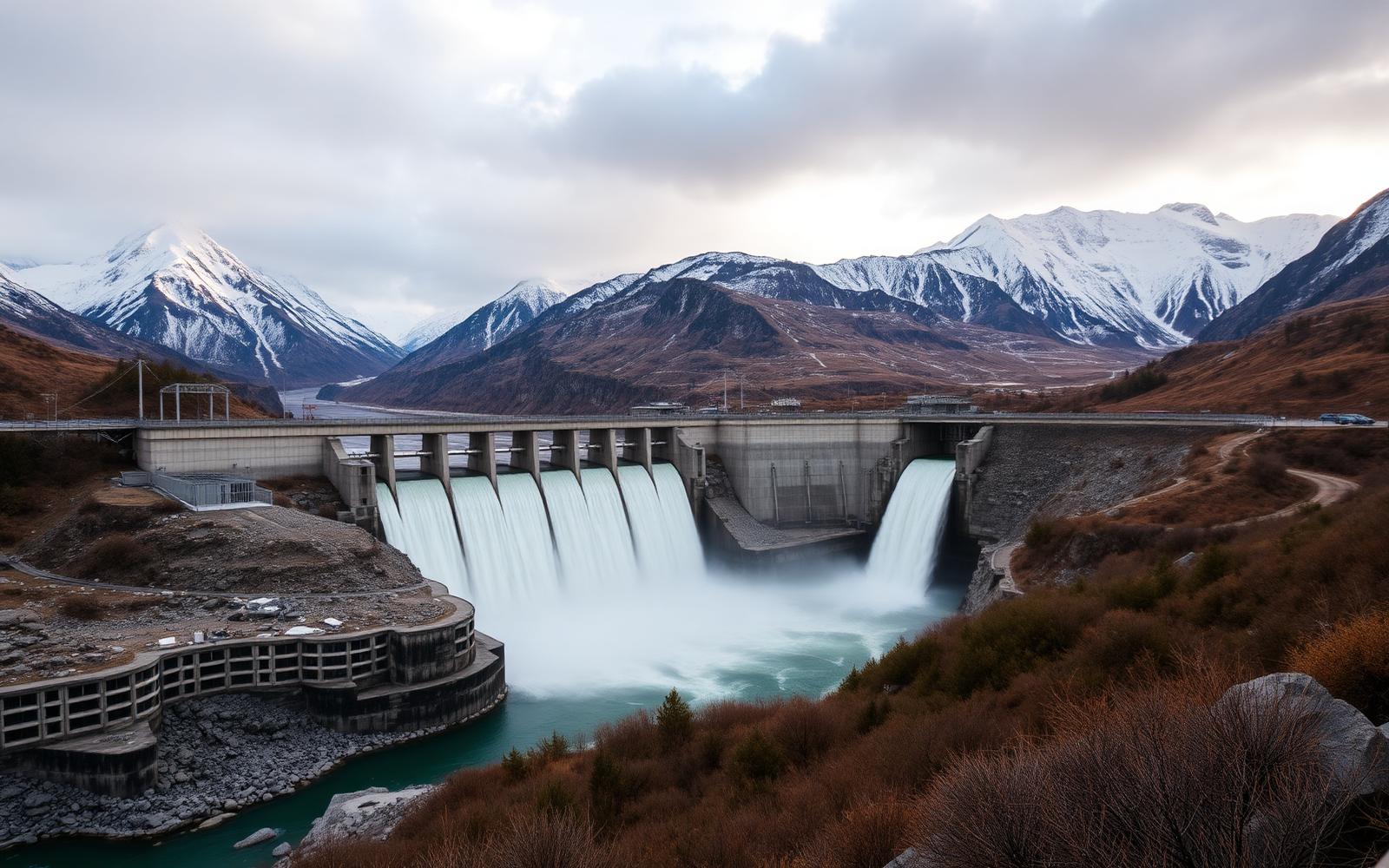
Snowpack: The Hydropower Industry’s Quiet Headache

Why a melting reservoir in the mountains is the most underpriced variable in power generation — felt most acutely in hydropower, increasingly across thermoelectric too.
Hydropower is the largest source of low-carbon electricity on the planet. It supplies roughly 15% of global generation — more than nuclear, wind, or solar individually — and the share runs far higher in countries that built their grids around it: nearly 100% in Paraguay, ~90% in Norway, more than 70% in Brazil, and over 60% in Canada. China alone generates more than 1,300 TWh of hydropower per year, about 31% of the world total. Tens of thousands of dams in the Alps, Andes, Rockies, Sierras, Himalayas, Hindu Kush, Caucasus, and Scandinavian highlands all depend on a single physical process: snow accumulating in the mountains during the cold season and melting in a predictable curve through the warm one. That curve is what gets dispatched, traded, hedged, and counted on for grid reliability. And that curve is changing fast. Mountain snowpack is shrinking, melting earlier, and behaving more erratically across nearly every snow-fed basin on Earth — and the forecasting infrastructure used to manage it was calibrated to a climate that no longer exists. Three reasons this is power generation’s quietest, fastest-growing risk:
1. The Hydrograph Is Reshaping Faster Than the Models
The climate signal in mountain snow is unambiguous and accelerating. Warmer winters convert more precipitation to rain instead of snow. Earlier and faster snowmelt shifts peak runoff from summer to spring. Rain-on-snow events drive sudden, hard-to-forecast pulses of water through systems designed for slow release. Late-season vegetation under drier conditions consumes more of what remains. The net result is a flatter, earlier, more volatile hydrograph — exactly the opposite of what reservoir operations, water rights frameworks, hydropower dispatch, and grid planning were built around. From the Colorado Basin to the Po, the Indus to the Rhône, snowpack declines, earlier runoff, elevated winter flows, and flattened hydrographs are converging with long-standing climate projections. The physics are clear; the forecasting infrastructure hasn’t caught up.
2. Hydropower Feels It First — Thermoelectric Is Next
For hydropower operators, snowpack is the fuel. When the forecast is wrong, reservoirs are mis-dispatched, generation is sold or hedged at the wrong prices, capacity payments are missed, and operators are forced to buy in spot markets at peak rates. Recent dry years across the western U.S., southern Europe, the Andes, and China’s Yangtze basin have already produced billion-dollar hydropower revenue shocks, forced grid emergencies, and pushed up regional emissions as gas and coal backfilled the shortfall. But the headache doesn’t stop at hydropower. Thermoelectric generation — nuclear, gas, and coal — depends on the same snow-fed rivers for cooling water, and is increasingly forced to derate or shut down when warmer, lower flows breach intake or discharge thresholds. The 2022 European drought curtailed thermal output across France, Switzerland, and Germany simultaneously with hydropower shortfalls. Snowpack risk is not a hydropower problem alone; it is increasingly a generation-portfolio problem.
3. A Technical Whitespace With a Global Buyer
The building blocks of a modern snowpack-forecasting stack exist but are fragmented: airborne lidar snow surveys, satellite-based snow water equivalent retrievals, distributed in-situ sensor networks, high-resolution land-surface and atmospheric models, and machine-learning approaches that fuse these into watershed-scale, decision-grade forecasts. Public agencies from California to the European Centre for Medium-Range Weather Forecasts to the Indian and Chinese hydrological services are explicitly calling for this upgrade. The buyers are global, sophisticated, and well-capitalized: hydropower operators and the utilities behind them, power traders, thermoelectric operators managing cooling-water risk, insurers writing parametric drought and generation products, and the AEC firms designing the next generation of storage and grid-firming assets. No single firm has yet consolidated this stack into a coherent commercial platform. The combination — physical exposure compounding annually across every snow-fed basin on Earth, sophisticated buyers with budget, fragmented incumbents, and a technical bar that rewards integration — is exactly the setup that produces category-defining companies.
Snowpack used to be power generation’s quietest input. In a warming climate, it’s becoming its loudest variable — and the firm that fixes the forecast doesn’t just sell better data. It sells reliability to the grid.