
Rain Stops Play
Heat gets the headlines. Hydroclimatic risk files the claims, and sport is where insurers are learning how hard those claims are to price.
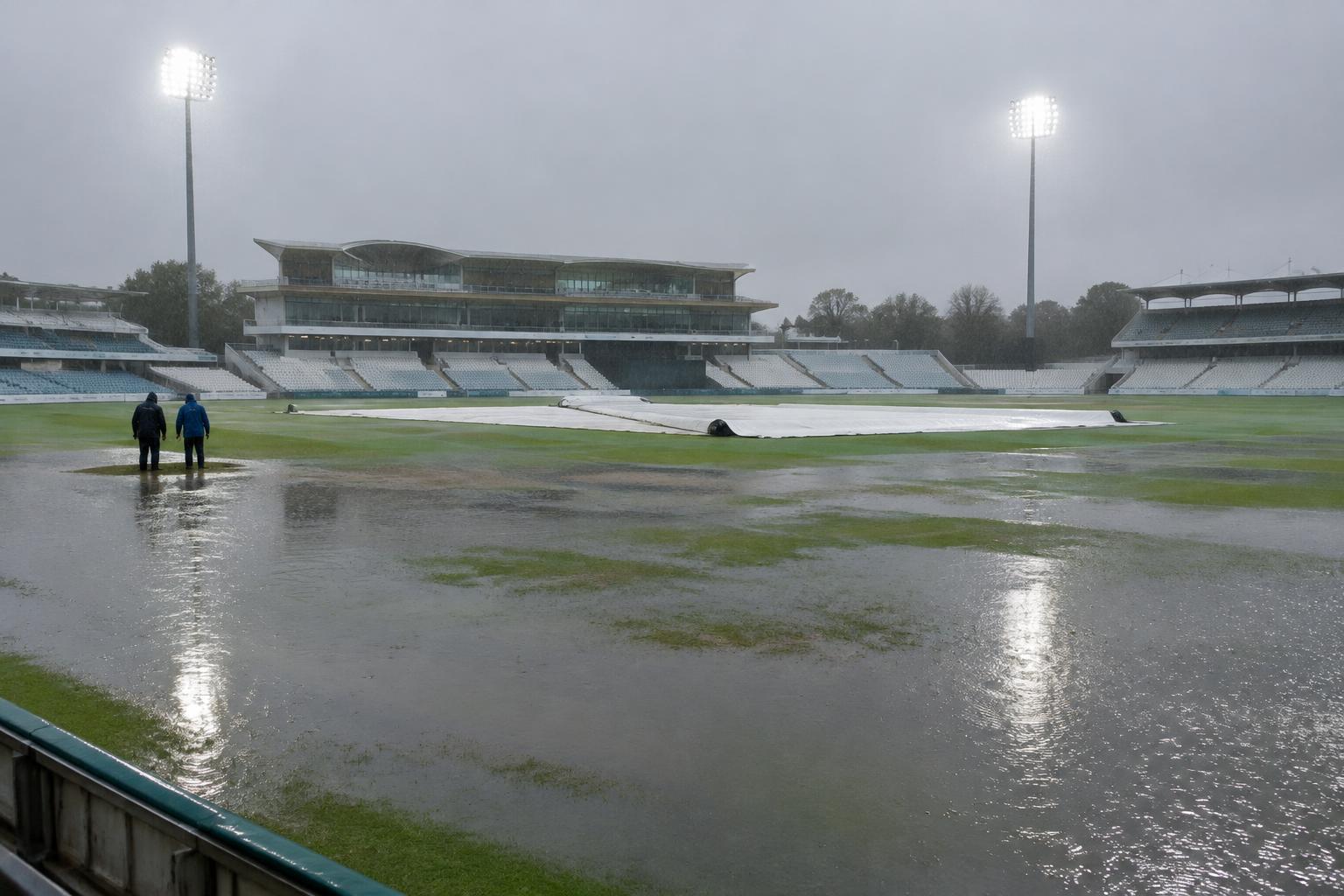
Marsh's new report, Changing the Playbook: Climate Risk in the Global Sports Industry, opens with one number that matters more than the rest: extreme weather drove 43% of Marsh's event cancellation claims between 2022 and 2025. The report also notes that 90% of sports organizations have no climate strategy. That figure describes a need. The 43% describes a loss ratio, and a loss ratio is what gets an industry to move.
Heat is a real and growing risk to athletes, fans and fixtures. It also sits outside our scope. This piece looks at the other half of the weather problem: hydroclimatic risk. That covers precipitation and its consequences, from too much and too little to too dirty and too unpredictable. It is the part of the problem insurers struggle with most.
Every sport already has a hydroclimatic failure mode
Too much. Formula 1 cancelled the 2023 Emilia-Romagna Grand Prix at Imola after deadly flooding across the region. At the 2024 T20 Cricket World Cup, three group matches in Lauderhill, Florida were abandoned without a ball bowled because of rain and a waterlogged outfield, which knocked Pakistan out of the tournament. In May 2024, floods in Porto Alegre submerged both of the city's top-flight football stadiums. At the grassroots, an estimated 120,000 football matches in England are lost to bad weather every year. About one in nine community rugby clubs in England sits in a designated flood zone.
Too little, too warm. Seven of the first eight races of the 2022–23 Alpine Ski World Cup were cancelled, mostly because of warm temperatures and a lack of snow. They included the debut of the Zermatt–Cervinia downhill, planned as the season's flagship event.
Too dirty. Paris spent around €1.4 billion to make the Seine swimmable. Heavy rain then overwhelmed the city's sewers, and the Olympic men's triathlon was postponed because bacteria levels failed safety thresholds. The rainfall itself didn't stop the event. What it did to the river did.
Too unpredictable. Typhoon Hagibis forced the cancellation of three matches at the 2019 Rugby World Cup in Japan. Insurers were expected to carry a bill of roughly £20 million.
The insurer is the compelled buyer, and the book is getting harder to write
The pattern goes beyond Marsh. Another US broker reports that severe weather now accounts for about 42% of its cancellation claims, up from 28% a decade ago. Premiums have tripled in some cases. Deductibles run as high as 10% of insured value. Cover near weather-prone zones comes with stricter underwriting, and in hurricane-exposed regions organizers are told to bind 30 to 40 days out or risk being refused. Brokers describe event cancellation moving away from near all-risk cover toward policies where clients have to buy back specific perils. At community level, a Rugby Football Union survey found clubs that could no longer get flood cover at all, and others facing premiums they attributed directly to flood risk.
Sport makes this book unusually hard to underwrite, for four reasons:
Losses are correlated. Tournaments cluster in one place at one time, so a single storm can cancel a whole slate of matches.
The events are one-offs. A final can't be moved to next week, and the broadcast revenue goes with it.
The trigger is often a decision, not a downpour. Umpires call off a match for a wet outfield, and organizers cancel on safety grounds. That leaves the adjuster arguing about what caused the loss.
The variables that matter are invisible to the underwriter. These include rainfall at the venue rather than at the nearest airport, how much water a pitch can drain, and how fast a river's bacteria levels recover after a storm. Asset-level data that would settle any of these questions rarely exists.
Resolution is the product
Parametric cover avoids most of these problems. The policy pays when a measured index crosses an agreed threshold: a set amount of rainfall at the stadium, snow depth on the piste, or a water-quality reading at the swim start. There is no loss adjuster, no argument over whether the cancellation was justified, and no wait of several months for payment. Brokers still call parametric event cover "niche but gaining traction." The constraint isn't demand. It's data.
A parametric trigger is only as good as the observation behind it. If the gauge is five kilometers from the ground, the policy can pay out on a dry pitch or fail to pay on a flooded one. That mismatch, known as basis risk, is the main reason buyers hesitate. Closing it takes hyperlocal precipitation sensing and forecasting, venue-level drainage and surface data, and near-real-time water-quality monitoring. In a parametric structure, resolution isn't a technical detail. It is the product. This is the layer where our portfolio company Sereno works in parametric insurance, and the layer we look for across our pipeline.
Sport is not a new sector. It routes into one we already know.
We won't be launching a sports thesis. Sport is a vertical that leads back to F.I.RE.: the specialty underwriters pricing cancellation and contingency risk, the property insurers covering stadiums, and the lenders financing venues that now flood. What sport adds is visibility. Every cancelled match is a hydroclimatic loss broadcast live, with a clear date, place and dollar figure.
Sport didn't become a hydroclimatic risk business this decade. It always was one. The insurer just started keeping score.
Sources
- Marsh, "Changing the Playbook: Climate Risk in the Global Sports Industry," via Global Sustainable Sport (27 Oct 2026); Skift Meetings (Aug 2025), citing Risk Strategies; Insurance Business, citing BFL Canada (Aug 2026); UK DCMS / Alma Economics, "Exploring the financial implications of climate change on grassroots sport" (2025), citing RFU (2025) and Hawkins et al. (2023); Lockton (Oct 2019); Outside (Nov 2022); contemporaneous reporting on Imola 2023, T20 World Cup 2024, Porto Alegre 2024 and Paris 2024.
Mazarine Climate maintains a database of early-stage companies with technology innovations dedicated to helping their customers manage hydroclimatic risk.