
Don't Bet on the Concrete
Concrete is how the world answers hydroclimatic risk. An early-stage adaptation investor shouldn't bet on the material. It should bet on what the material doesn't know.
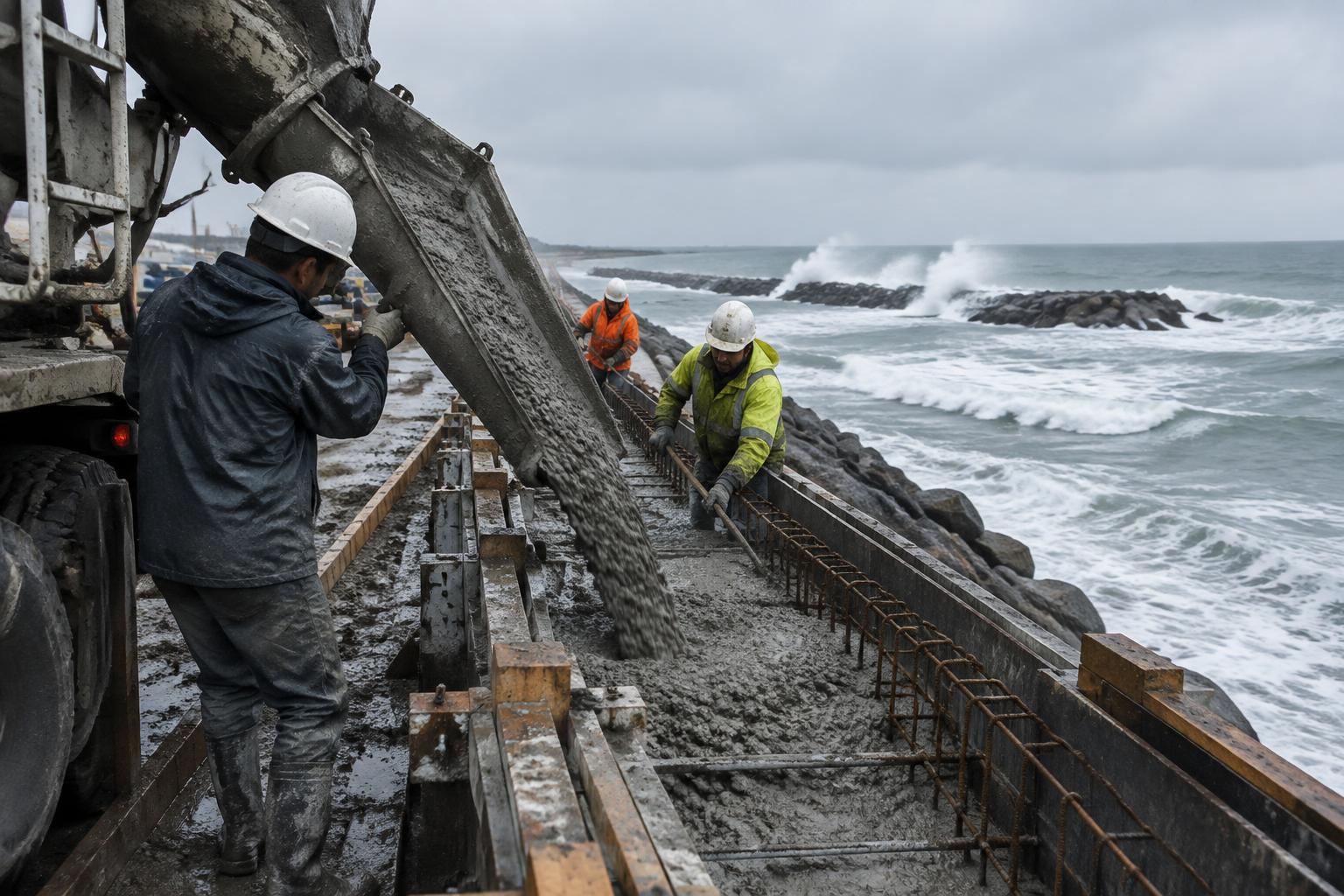
Someone put a fair challenge to us. If concrete is how humanity adapts, through seawalls, levees, raised foundations and storm basins, why isn't Mazarine investing in it?
The premise is right. Concrete makes up roughly half the mass of everything humans have built. Japan has just finished a $12B, 250-mile seawall network. Singapore expects to spend about $100B on coastal defenses over the coming century. When water arrives wrong, the world pours.
The obvious play is next-generation concrete: lower-clinker, carbon-negative, self-healing. It's real innovation, and it isn't our play. New materials must prove themselves against a century-long durability record and conservative building codes. They scale through capital-intensive plants, and they sell into a commodity market where the incumbents run their own venture arms. Most of all, cleaner concrete is a mitigation thesis: it changes what the material emits, not what it protects against.
The adaptation question is different. Concrete is the answer the world has already chosen. What's missing is the information around it: how much to pour, whether it's holding, and who pays when it doesn't. That's where we play.
Every pour is a forecast
A seawall's height is a bet on a hazard 50 to 100 years out. Overbuild and you strand capital in a structure nobody needed. Underbuild and it fails the one night it matters. Either way, the concrete is only as good as the hazard model that sized it.
That makes decision support the highest-leverage layer. The data that sizes a pour costs a small fraction of the pour, and on a multibillion-dollar program that fraction is large. Company A, from Israel, builds calibrated, street-level flood models of urban drainage networks for municipalities and utilities; on one tested upgrade it reports roughly a 40% capex reduction. Company B, from the UK, produces high-resolution coastal flood and erosion layers for ports, real estate owners and insurers, so defenses are priced and placed against real exposure rather than static maps.
The buyer is compelled. Adaptation capex is being spent regardless. The question is whether it's spent on the right wall, in the right place, at the right height.
Concrete fails slowly, then all at once
Once poured, concrete becomes an asset whose condition nobody can see. Hydroclimatic risk attacks it in two ways. Salt water drives chloride into reinforced concrete and corrodes the steel inside; corrosion is the main way reinforced concrete degrades, often turning critical around 50 years. Floods strip sediment from around bridge piers and foundations; scour is the leading cause of bridge failure worldwide. Sea-level rise moves more concrete into the splash zone, and heavier floods move more water past every pier.
Today most of this is checked on an inspection calendar, by divers and engineers, every few years. The investable wedge is continuous condition data, and ideally data triggered by the hazard itself: what the quay wall, pier or seawall looks like after the surge, not at the next scheduled visit.
Where we see it emerging:
Company C, from Switzerland, embeds chloride and pH sensors in reinforced concrete and sells the analytics to transport-infrastructure owners.
Company D, from Israel, turns repeat seabed surveys into automated change detection for ports, offshore energy and subsea cable operators.
Company E, from Austria, runs autonomous underwater inspections of harbor walls, replacing divers with repeatable 3D scans.
A portfolio company, TDRI, measures moisture inside road pavement for highway agencies, the linear-asset version of the same problem.
One gap stands out. Real-time scour sensing is still mostly a university pilot. We're actively looking for the team that takes it to market.
When concrete fails, someone pays
Every wall that overtops and every pier that scours produces a loss, and every loss lands on a balance sheet: the owner, the lender, the insurer. Those parties are now pricing hydroclimatic risk under disclosure rules and insurance repricing, and they need evidence specific to the asset, not regional averages.
A new payer is also arriving. A Swiss court recently allowed residents of a sinking Indonesian island to take a climate claim against a major cement producer to trial. As Ted C. Fishman documents in Bloomberg Businessweek, concrete makes up half of all human-made stuff on the planet, its use is set to double, and on Pari Island it is both part of the reason the sea is rising and the thing now holding it back. If liability for climate harm takes hold, emitters and their insurers become buyers of something that barely exists today: defensible, asset-level evidence linking a specific flood to a specific loss.
This is where condition data compounds. The same feed that tells an engineer a seawall is degrading tells an underwriter what to charge, a parametric contract when to pay, and a court what happened. A portfolio company structuring parametric cover depends on exactly that: in parametric insurance, data resolution isn't a technical detail, it's the product.
The answer to the challenge
If concrete is how the world adapts, the venture question isn't how to make better concrete. It's how much to pour, where, how long it will hold, and who pays when it doesn't. Each of those is a data problem, and data problems are venture problems.
We don't invest in the concrete. We invest in what it's holding back.
Mazarine Climate tracks 159+ early-stage companies classified as hydroclimatic risk.